Tune across a busy band for the first time and it sounds like everyone’s speaking in code. That’s because they kind of are. Ham radio Q codes are short three-letter shortcuts operators use to say a lot with very little, and once you know the common ones, the chatter suddenly makes sense.
This guide covers the Q codes you’ll actually hear, what each one means, and how to use them without sounding like you’re reading from a manual.
What Are Ham Radio Q Codes?
Q codes are standardised three-letter signals that all start with the letter Q. Each one stands in for a whole phrase. Instead of saying “what is your location,” you say “QTH.” Instead of “I am being interfered with,” you say “QRM.”
They were invented back in 1909 for maritime radio, when every second of Morse code cost time and effort. Spelling out long sentences in dots and dashes was painful, so operators agreed on a shared shorthand. Hams adopted them, and they stuck around long after Morse stopped being mandatory.
Here’s the clever part: a Q code can be a question or an answer depending on context. “QTH?” means “where are you?” Drop the question mark and “QTH London” means “my location is London.” Same three letters, two jobs.
The Q Codes You’ll Hear Most
There are dozens of Q codes, but you don’t need them all. Master these and you’ll follow almost any conversation on the air:
- QTH — Your location. “My QTH is Cape Town.”
- QSO — A conversation or contact between two stations. “Thanks for the QSO.”
- QSL — I acknowledge / I confirm. Also the name for the postcards hams swap to confirm a contact.
- QRZ — Who is calling me? Often heard as “QRZ?” after a station hears a partial callsign.
- QRM — Man-made interference, usually from other stations.
- QRN — Natural interference, like static from a thunderstorm.
- QSB — Your signal is fading up and down.
- QRP — Low power operating (running 5 watts or less for the challenge of it).
- QRT — I’m shutting down the station. “I’m going QRT for dinner.”
- QRX — Stand by, wait a moment.
- QSY — Change frequency. “Let’s QSY up 5.”
- QRL — Is this frequency busy? Always ask before you start calling on an empty-sounding frequency.
If you only memorise five, make them QTH, QSO, QSL, QRM, and QRZ. Those five carry most casual conversations.
How Q Codes Actually Get Used
Q codes started life in Morse code, but plenty of hams use them in normal voice contacts too. On a voice contact you might hear: “You’re 59 here, but there’s some QSB and a bit of QRM on the low side, so let’s QSY up 3.” Translated: your signal is strong, it’s fading slightly, there’s interference, and they want to move up the band a little.
A quick note on etiquette. On voice, you don’t have to use Q codes for everything. Saying “what’s your location” is perfectly fine and arguably clearer. Q codes shine on Morse code and digital modes where brevity genuinely matters. On voice, sprinkle them in naturally rather than forcing every sentence through a translator.
Q Codes vs the 10-Codes You Might Know
If you’ve used CB radio or heard police scanners, you might know “10-4” for “understood.” Those are 10-codes, and they’re a different system. Ham radio uses Q codes instead, not 10-codes. Mixing them up is a classic new-operator giveaway, so if you’re coming from CB, this is the swap to make.
One more overlap worth knowing: the signal report system. When someone gives you a “59,” that’s the RST report (readability, signal strength, tone), not a Q code, but it usually shows up in the same breath as QSB and QRM, so it’s good to recognise it.
Tips for Learning Them Fast
Don’t try to memorise a giant list. It won’t stick and you’ll bore yourself. Instead:
- Listen first. Spend an evening just tuning around and listening. You’ll hear the same handful of codes over and over. Repetition does the work for you.
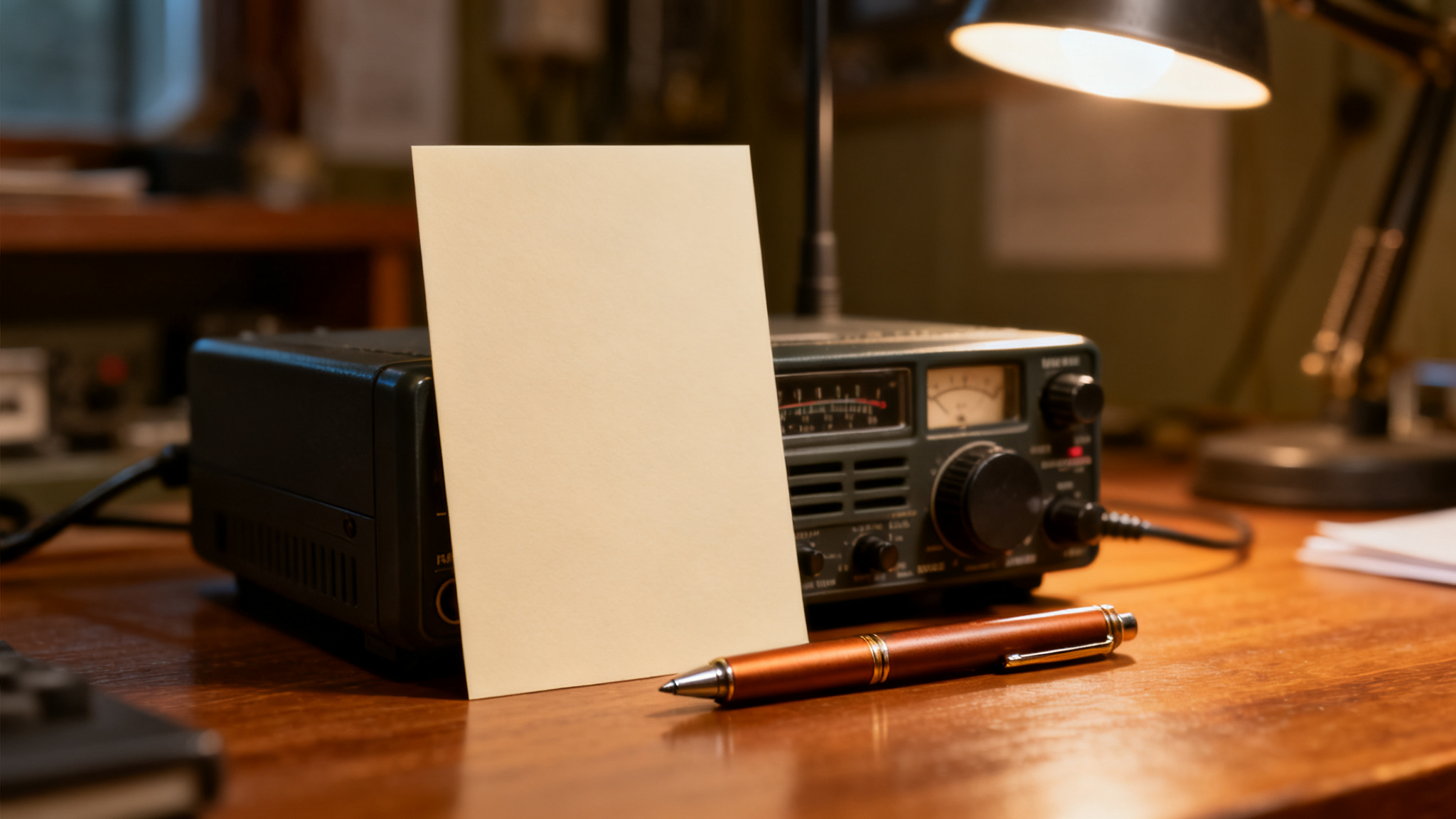
- Keep a cheat sheet. Stick the dozen common codes on a card next to your radio. Glancing at it during a contact is completely normal, and nobody can see you do it anyway.
- Learn them in context. “QRT for dinner” sticks better than “QRT: I am closing my station.” Tie each code to a sentence you’d actually say.
Within a couple of weeks of regular listening, the common codes will feel like second nature and you’ll stop translating them in your head.
Ready to Get on the Air With Confidence?
Q codes are one small piece of getting comfortable on the radio. The bigger picture is knowing the full path from “complete beginner” to “licensed and making contacts” without the overwhelm.
That’s exactly what our free New Ham’s Quick-Start Checklist is built for. It walks you through getting licensed, choosing your first radio, setting up your station, and making that first contact, step by step. Grab the free checklist on Ham Radio Planet and start working through it one step at a time.