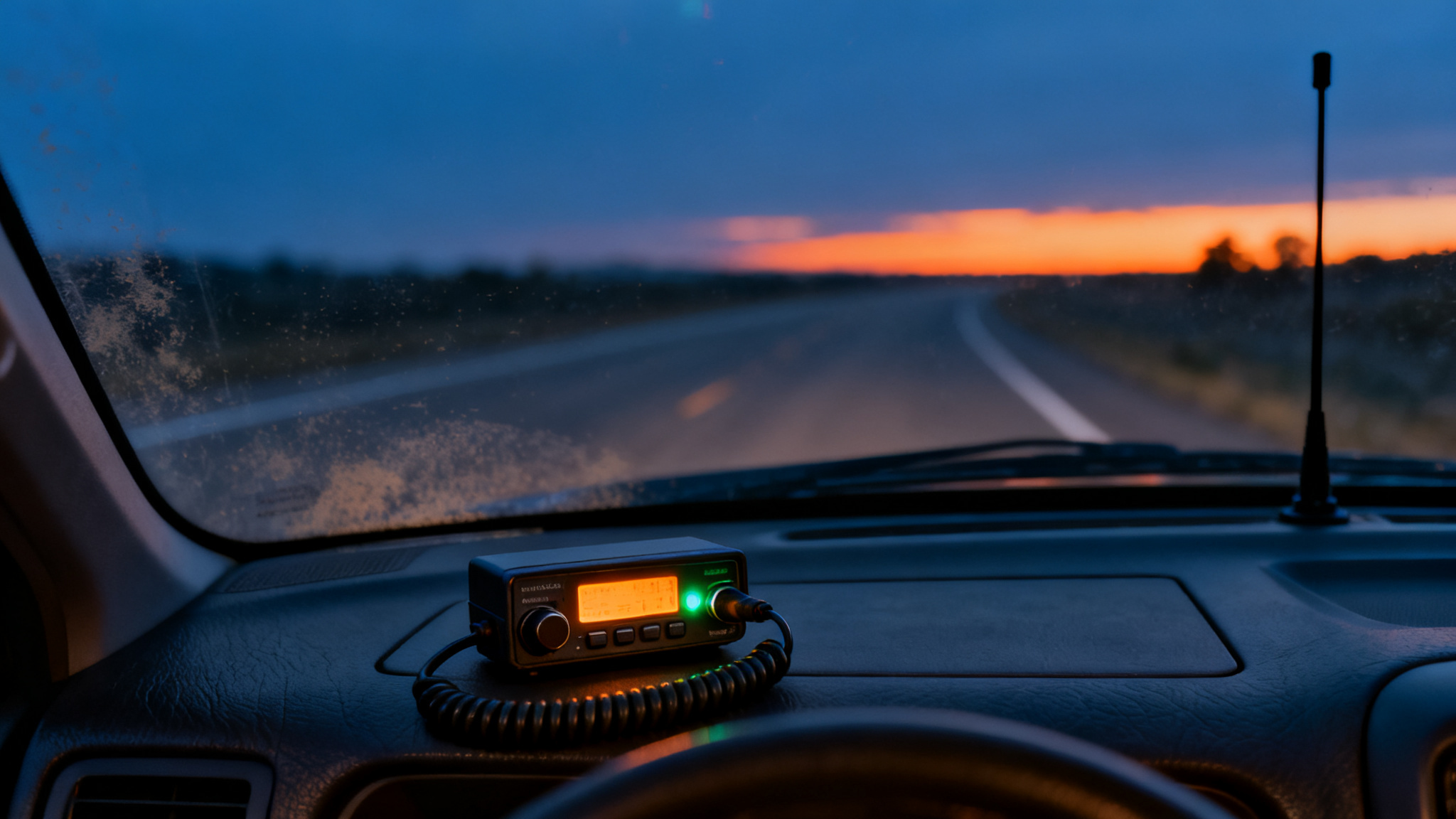
Putting a ham radio in your car turns dead commuting time into airtime. This guide covers what to buy, where to stick the antenna, how to wire it without cooking your electrics, and how to operate safely once it’s all in.
Fair warning: once you’ve had a decent chat while sat in stationary traffic, you’ll start hoping for a jam.
Why Bother With a Radio in the Car?
Three reasons, and the first one is the big one.
Range. A handheld puts out about 5 watts into a stubby little antenna at chest height. A mobile rig puts out 25 to 50 watts into a proper antenna sitting on a metal roof, with the whole car acting as a ground plane. The difference isn’t small. Repeaters you could barely scratch from your kitchen suddenly come through like they’re next door, and you’ll work them from 30 or 40 miles out on a clear run.
Time you’re already wasting. Most of us spend hours a week driving. That’s hours of listening, checking into nets, and actually using the licence you studied for instead of admiring it on the wall.
Backup when things go sideways. Breakdown in a valley with no phone signal, a road closed by weather, a proper emergency. A car with a working radio in it is a car that can still call for help.
Choosing a Mobile Radio
For your first mobile setup, get a dual-band VHF/UHF rig — that’s 2 metres and 70 centimetres, the two bands where nearly all the repeater activity lives. Somewhere between 25 and 50 watts is plenty. You do not need more.
Things worth paying attention to:
- A detachable face. The control panel comes off the radio body, so you can bolt the heavy box under a seat and mount just the display where you can reach it. In a modern car with no spare dashboard real estate, this is close to essential. We’ve covered the options in our guide to ham radios with detachable faces.
- A big, readable display. You’ll be glancing at it, not studying it. Small grey-on-grey screens are miserable in daylight.
- Chunky buttons and a proper volume knob. Anything you can’t work without looking is a design you’ll come to resent.
- Cross-band repeat, maybe. Handy later on, ignorable for now.
Skip HF in the car for the moment. Mobile HF is genuinely brilliant, but it’s a bigger antenna problem, a bigger noise problem, and a much better second project than a first one. If you’re curious about what you’re missing, start with what HF ham radio actually is. Not sure which rig to pick? Our roundup of the top mobile ham radios is a decent shortlist.
The Antenna Does Most of the Work
Here’s the thing nobody tells beginners: a cheap radio with a good antenna beats an expensive radio with a bad one. Every time. Spend accordingly.
Your three main options:
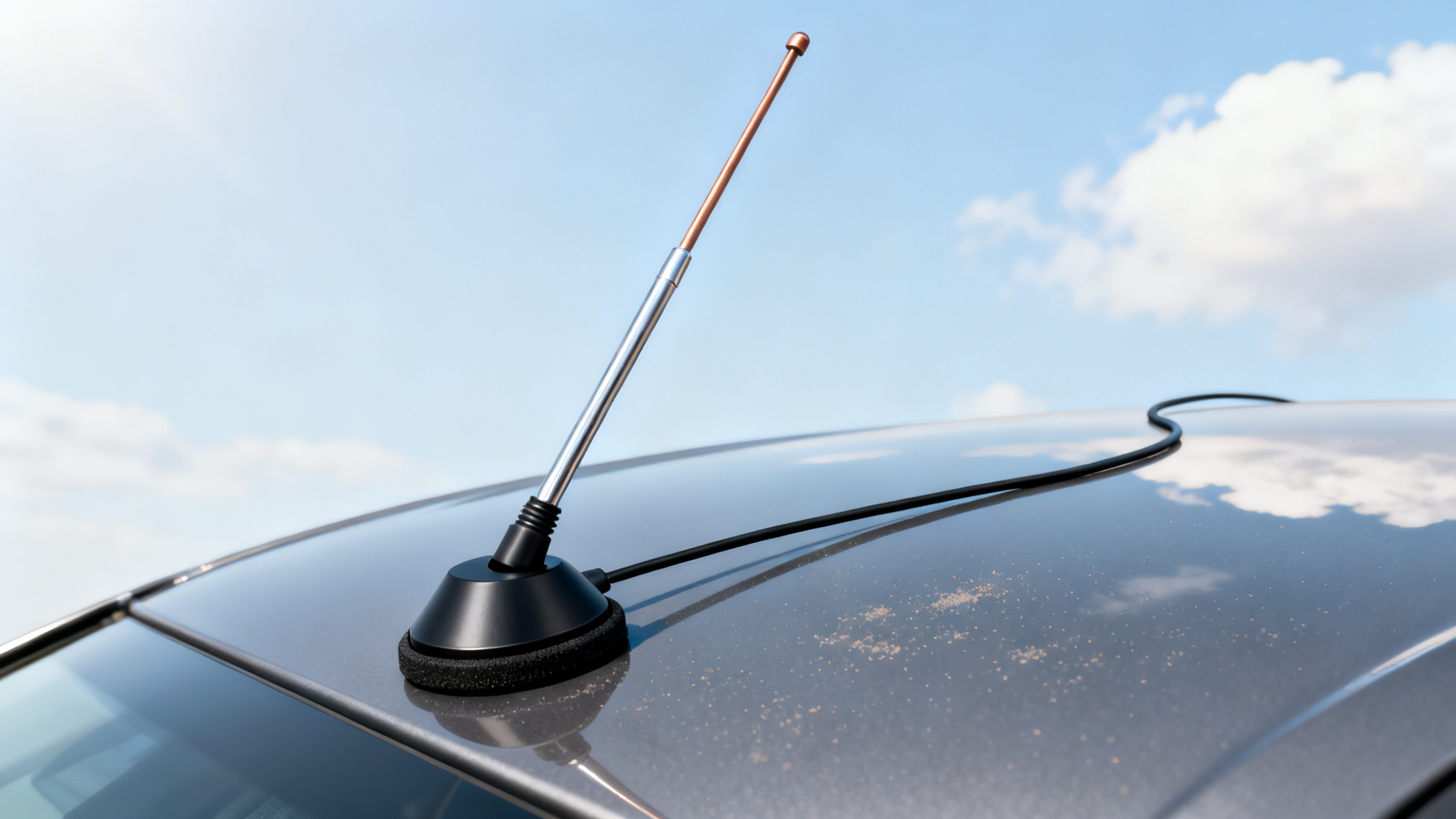
- Magnetic mount. A magnet base that sticks to the roof, cable trailing in through a door seal. Zero holes, zero commitment, works surprisingly well. Perfect for a first setup or a car you don’t own.
- Lip or bracket mount. Clamps to the boot lid or bonnet edge. More permanent-feeling, still no drilling. Slightly worse position than the roof, but usually good enough.
- NMO through-hole. You drill a hole in the roof. This is the best-performing option by a clear margin, and also the one that makes people go pale. Done properly it’s weatherproof and lasts the life of the car.
Position beats everything else. Centre of the roof is the gold standard, because the metal around the antenna acts as the ground plane it needs to work. Push it to the edge of the boot lid and you’ll radiate unevenly, with a weaker signal in some directions than others. If you’ve got the choice, go high and go central. Our guide to ham radio car mounts goes deeper on the trade-offs.
Check your SWR before you transmit properly. SWR is just a measure of how much of your power is going out of the antenna versus bouncing back into your radio. Under 1.5:1 is happy. Over 2:1, stop and fix it — usually by trimming the antenna whip a few millimetres at a time. Trim too much and there’s no putting it back, so go slowly.
Power It Properly the First Time
This is where people take shortcuts and later regret them.
Don’t run a 50-watt radio off the cigarette lighter socket. That circuit is often fused for around 10 to 15 amps, and a rig at full output can pull 10 to 12 on its own before anything else in the car gets a look in. You’ll be resetting fuses, watching the display dim mid-transmission, and wondering why everyone says you sound rough.
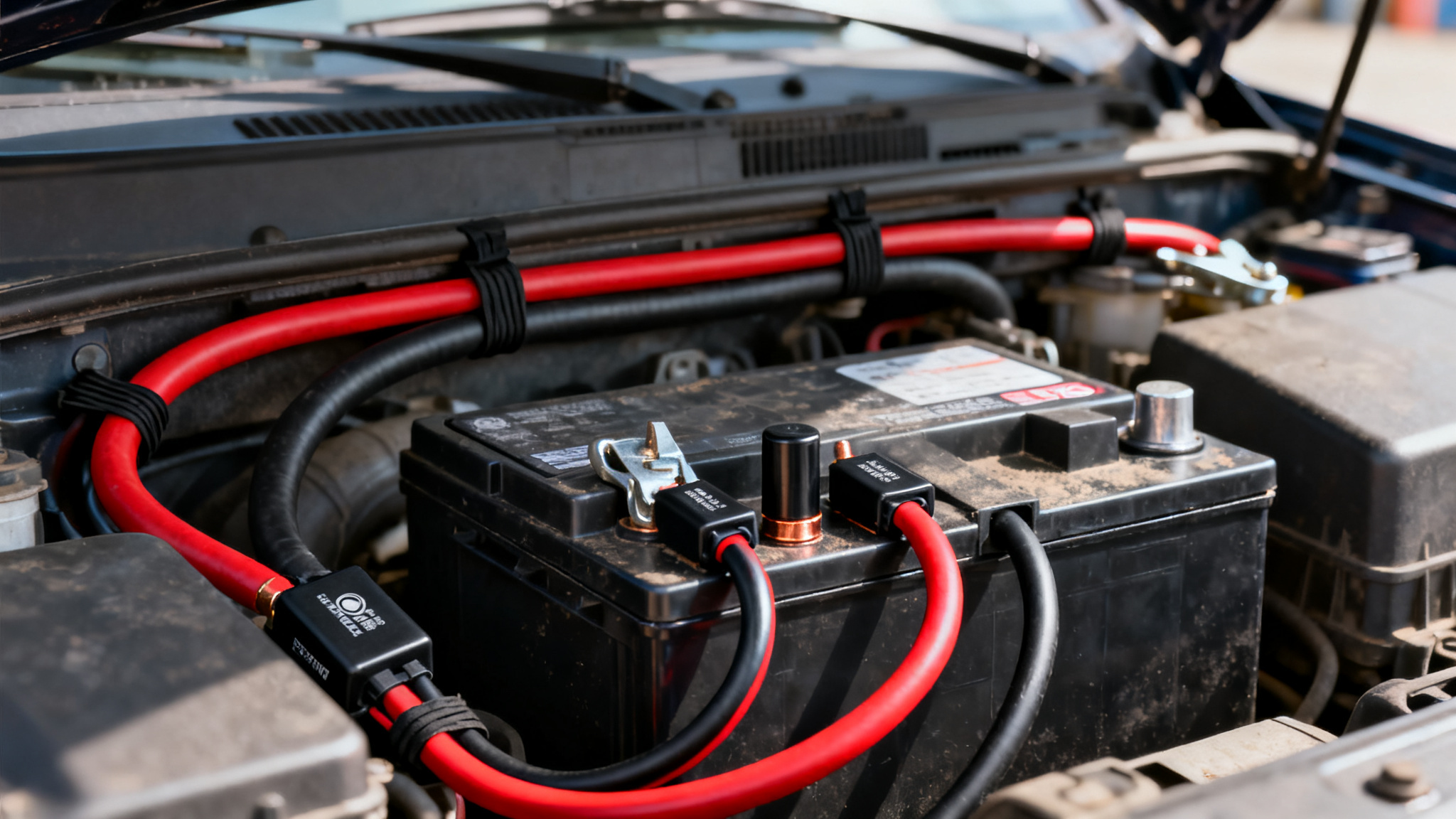
Run it straight to the battery. Use the proper thick cable that came with the radio (usually around 12 gauge), keep it as short as sensibly possible, and fuse both the positive and negative leads within about 45cm of the battery terminals. Both. The negative lead matters because in a knock, the car body can become part of the circuit in ways nobody planned for.
Where the cable passes through the bulkhead, use an existing grommet or fit a new one. Bare wire through a sharp metal hole will eventually chafe through, and a short circuit under the bonnet is a very bad afternoon.
If you get a whining noise that rises and falls with the engine, that’s alternator whine sneaking in through the power leads. Going direct to the battery fixes it most of the time. If it persists, a noise filter on the power line usually finishes the job — see our notes on ham radio noise filters.
Mounting It Without Wrecking the Car
Two rules, both non-negotiable.
Nothing goes in an airbag deployment zone. Not the radio, not the control head, not the microphone clip. An airbag fires fast enough that anything sitting in front of it becomes a projectile aimed at your face. Check your handbook for where the airbags are before you drill or stick anything anywhere.
Nothing blocks your view or your controls. Sounds obvious. Then someone mounts a control head right where they need to see a roundabout.
Beyond that: put the mic where your hand naturally falls, run cables under trim rather than across the footwell, and leave a bit of slack so nothing pulls tight when the seats move. Use proper mounting brackets rather than sticky pads for anything heavy. Everything in a car vibrates loose eventually.
Operating While You Drive
Driving comes first. Always. The radio is the thing you do with your spare attention, not the other way round.
A few habits that make it easy:
- Set up before you move. Programme your local repeaters into memory channels while parked. Fiddling with frequencies at 60mph is how you end up in a hedge.
- Say you’re mobile. “This is [your call sign], mobile.” It tells everyone you might drop out under a bridge and that you’re not going to be taking down long messages.
- Keep transmissions short. Nobody expects a mobile station to hold court. Shorter overs also mean more time with both hands free.
- Learn one repeater properly first. Pick the one covering your commute and get comfortable with it before collecting fifty more. If repeaters are still a mystery, start with what a ham radio repeater is.
- Check the law where you live. Distracted driving rules vary by country and, in the US, by state. Many places specifically exempt two-way radio, some don’t. Ten minutes of reading now beats a fine later.
Never spoken on the air at all yet? Our walkthrough on making your first contact takes most of the nerves out of it, and ham radio lingo covers the vocabulary you’ll hear on the repeater.
Ready to Get on the Air From the Driver’s Seat?
You don’t need the perfect installation to start. Buy a dual-band mobile, put a magnetic mount antenna on the middle of the roof, wire it straight to the battery with fuses on both leads, and programme in your two nearest repeaters. That’s a working mobile station in an afternoon, and you can upgrade to a drilled NMO mount once you’ve decided you love it.
Then just drive somewhere and listen. You’ll be surprised how much is going on above your head that you’ve been driving through all this time.
If you’d like the whole setup laid out in order, grab our free Ham Radio Quick-Start Checklist. It runs from licence to first contact so nothing gets forgotten along the way. Get your free checklist here, then go put something on your roof.